Last May, Dario Amodei said half of all entry-level white-collar jobs were going to vanish.
This May, sitting next to Jamie Dimon in Lower Manhattan, he told a different story.
The technology didn't change. The story changed.
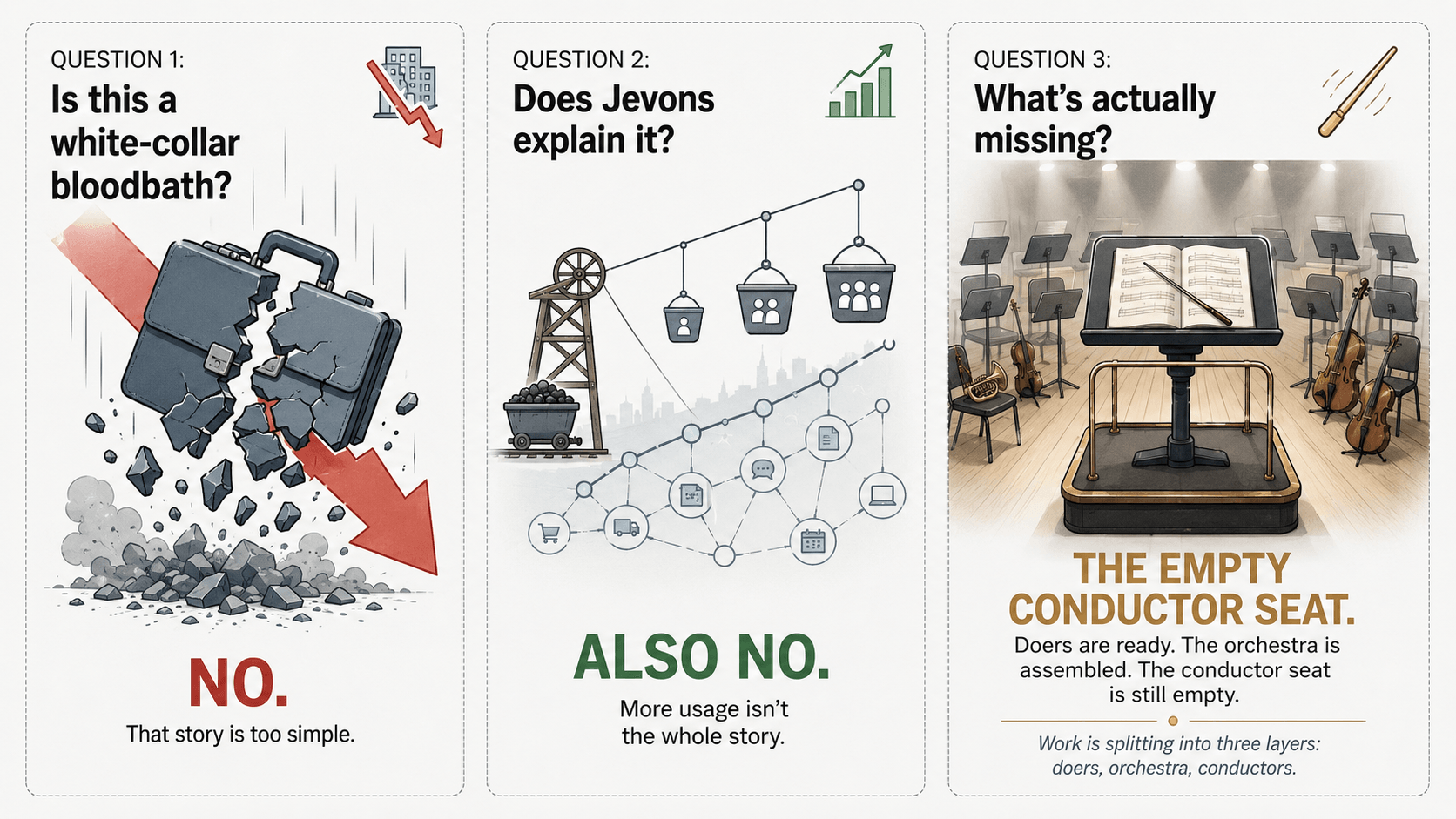
The new story is the Jevons Paradox. A 19th-century coal economist's idea: when something gets cheaper, we use more of it. Cheaper steam, more coal. Cheaper lawyering, more lawyering. So AI won't kill jobs. It'll make more of them.
Comforting.
Also slow.
ATMs didn't kill bank tellers in a week. They killed them across two decades. The local paper didn't disappear overnight. It took twenty years.
AI doesn't have twenty years.
Here's my thesis: Bloodbath is wrong. Jevons is wrong. Work isn't dying and it isn't doubling. It's splitting in three. And nobody on stage will tell you what the three are.
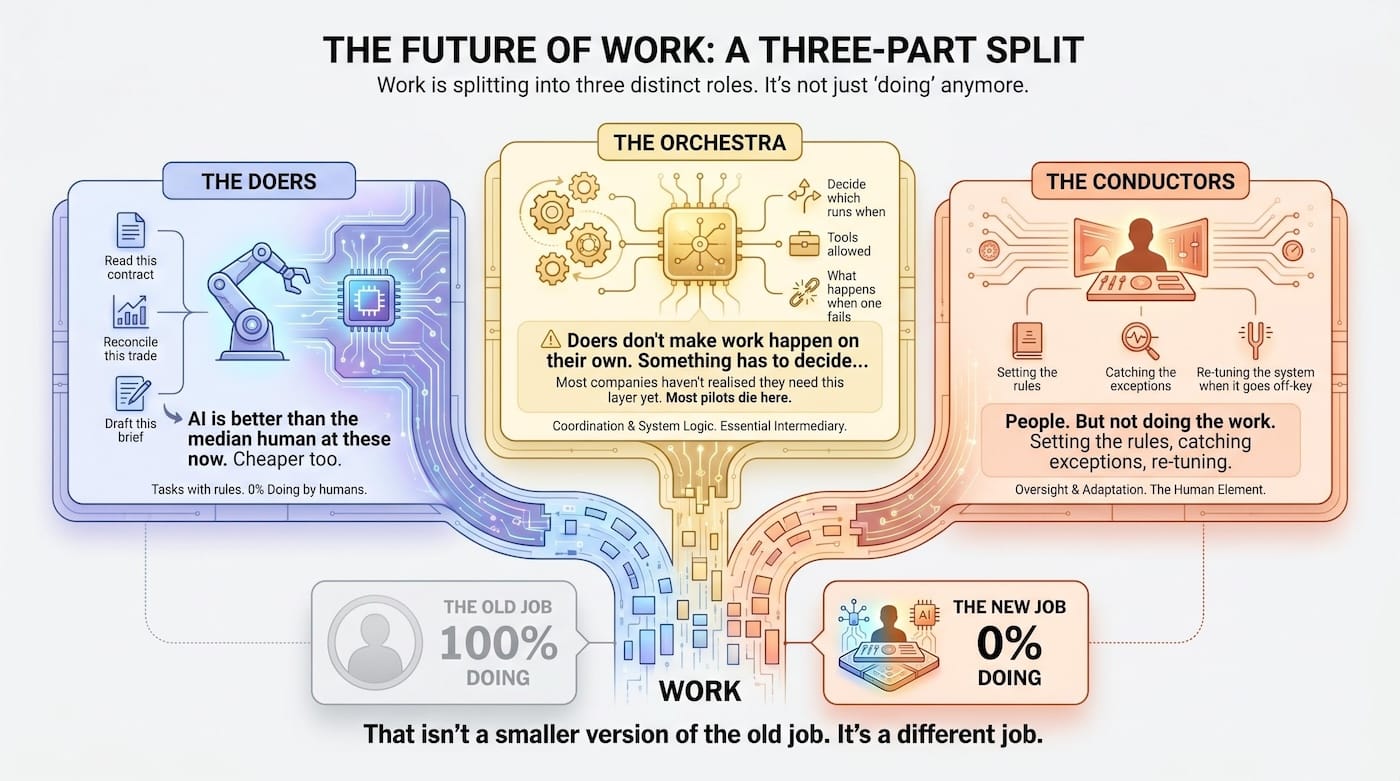
Work is splitting into three things, not two
The doers. Tasks with rules. Read this contract. Reconcile this trade. Draft this brief. AI is better than the median human at these now. Cheaper too.
The orchestra. Doers don't make work happen on their own. Something has to decide which one runs when, what tools each one is allowed to touch, what happens when one fails. Most companies haven't realised they need this layer yet. Most pilots die here.
The conductors. People. But not doing the work. Setting the rules. Catching the exceptions. Re-tuning the system when it goes off-key.
The old job was 100% doing.
The new job is 0% doing.
That isn't a smaller version of the old job. It's a different job.
The 10% trick doesn't add up
Amodei said: "If you automate 90% of the job, then everyone does the 10% of the job. And the 10% kind of expands to be 100% of what people do and kind of 10xs their productivity".
This sounds right. It isn't.
The 10% isn't the leftover slice of the old job. It's conducting. It looks different. It requires different skills. Most people aren't trained for it. Most companies haven't written the job description.
The 10% doesn't expand on its own. Somebody has to build it.
The bloodbath and the boom are both choices
The path of least resistance is the bloodbath. Pick a workflow. Replace the cheapest humans on it. Book the savings. Repeat.
Q3 looks great. The next decade doesn't.
The Jevons path is harder. Pick five workflows that move the P&L. Build the orchestra once. Pay your best people to be conductors. Then build the next five.
Most enterprises are doing the first thing.
Almost nobody is doing the second.
This is what we build at Riafy. We call it R10. Doers. An orchestra. A way to turn humans into conductors. That's the work. That's the whole pitch.