
In Davos, "bubble" is a polite word. It's what you say when you don't want to accuse anyone of selling snake oil to sovereign wealth funds.
On stage, Satya Nadella offered the cleanest definition: if AI doesn't spread beyond tech firms - if we're only talking supply-side winners - then it's a bubble by definition.
Larry Fink took the opposite headline - not a bubble - then immediately described the same structural risk: if the upside gets trapped inside a handful of hyperscalers, the AI "revolution" can stall.
That's not a contradiction. It's a disagreement about where the pain will show up.
Because bubbles don't end when the tech stops working. They end when someone downstream gets tired of paying for things that don't survive contact with reality.
The part Davos won't say out loud
Most AI failures aren't dramatic. They don't look like a dotcom crash.
They look like:
- the pilot that "went well" but never got security sign-off,
- the agent that's amazing until the first edge-case,
- the CFO who asks for "cost per resolved case" and gets a token chart,
- the ops lead who quietly turns the feature off at 2 a.m.
In other words: the bubble pops when the incentives meet the workflow.
And Davos is full of incentives.
Bubble talk is really three separate arguments
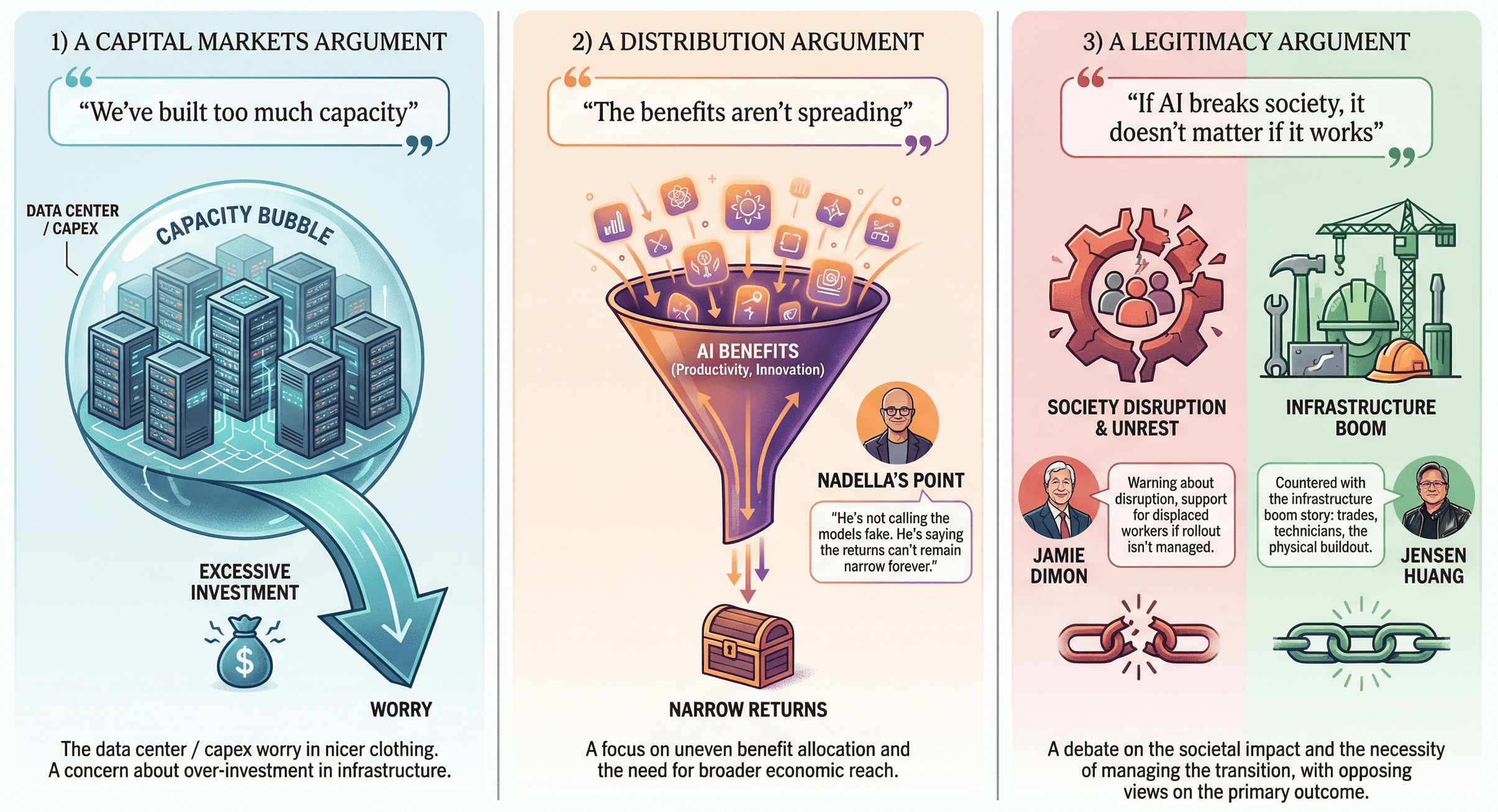
1) A capital markets argument: "We've built too much capacity". This is the data center / capex worry in nicer clothing.
2) A distribution argument: "The benefits aren't spreading". That's Nadella's point. He's not calling the models fake. He's saying the returns can't remain narrow forever.
3) A legitimacy argument: "If AI breaks society, it doesn't matter if it works". Jamie Dimon went there directly - warning about disruption and unrest if rollout isn't managed, with support for displaced workers. Jensen Huang countered with the infrastructure boom story: trades, technicians, the physical buildout.
Davos treated these as separate panels. They're the same system.
What Riafy thinks the market is mispricing
Here's the unpopular take: the "bubble" (if we must use the word) isn't about model capability.
It's about operational liability.
The industry is getting better at making systems that sound right. It's still learning how to make systems that stay right when:
- incentives reward speed over correctness,
- evaluations drift the moment the environment changes,
- tools make it easy for a confident mistake to become a real action,
- and the organization needs a human to own the outcome.
That's why I don't find the "bubble vs not-a-bubble" debate very interesting.
The more useful question is:
Who is holding the bag when an AI system is wrong - and it's wrong in a way that looks correct?
If the answer is "the vendor", you'll see pricing models change. If the answer is "the customer", you'll see adoption slow. If the answer is "society", you'll see regulation sprint.
All three are already starting.
Diffusion is not a vibes problem. It's an interface problem.
Nadella's "diffusion" framing lands because it points at the real constraint: AI has to move from boardroom fascination to line-of-business muscle memory.
But diffusion doesn't happen because the model got 2 points higher on a benchmark.
It happens when the system:
- behaves predictably under load,
- makes uncertainty visible,
- escalates before it guesses,
- and can be audited by people who don't care about your architecture diagram.
That last part matters more than Davos admits. Because "trust" isn't a moral achievement. It's a paperwork achievement.
So is it a bubble?
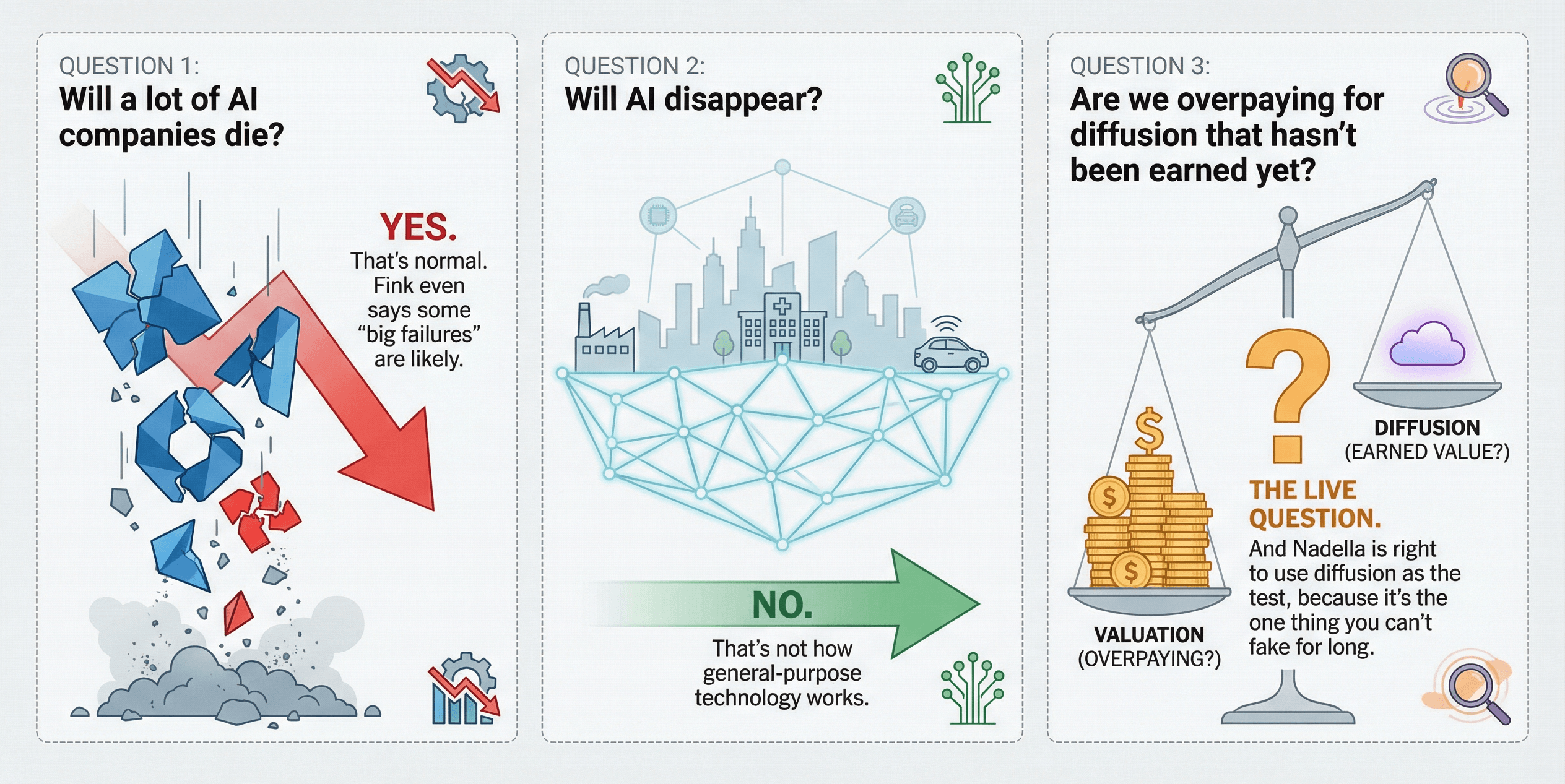
If you mean: "Will a lot of AI companies die?" - yes. That's normal. Fink even says some "big failures" are likely.
If you mean: "Will AI disappear?" - no. That's not how general-purpose technology works.
If you mean: "Are we overpaying for diffusion that hasn't been earned yet?" - that's the live question. And Nadella is right to use diffusion as the test, because it's the one thing you can't fake for long.
Davos will keep debating bubbles because it's safe and abstract.
We care about the less glamorous debate: Who is building AI that survives budgets, audits, edge-cases, and Monday morning?
That's where the next chapter gets written.